
A Ghost for a Father
The Granny Gatehouse Project #2

A couple of weeks ago in Family Fairytales I kicked off ‘The Granny Gatehouse Project’ a series of posts about Granny G - Dads mum - and our efforts to try and understand her life story.
As a child I absorbed the story that she’d been dumped on the steps of a church at 2 years old and was brought up by the vicar and her sister. A profoundly deaf child whose family couldn’t cope with her. Mum corrected my version and said that she was left on the steps of a nunnery at 3 years old. But as we know now both versions were actually family fairytales and a sanitized, fictional account of what really happened. Today I thought I’d continue the series by starting from the very beginning - her birth, her parents, and her early years.
I should also note that we are still in the process of trying to find out more. As anyone who has done any family history research knows we think that the information we have currently is correct, but sometimes you can find out later that you had some or even all of it wrong!
And don’t forget, if you prefer to listen to this post then you can click on the play button to hear my voiceover. Enjoy!
Ellen French, who would later be known as Granny G, was born on Tuesday 24th November 1903, at 11 Tilson Road in Peckham. An address that no longer exists. Apparently the weather that month was fine, dry, and sunny, with a fair amount of fog and frost, but nothing noted as severe - unlike the (historically) torrential rain the month before.
She was born just seven weeks before the Wright brothers successfully flew the Wright Flyer for the first time at Kitty Hawk, North Carolina on 17th December 1903. In the summer of that year the inaugural Tour de France was held and won by French bike rider Maurice Garin. And a number of well known celebrities - such as Bing Crosby (3rd May) and George Orwell (25th June) - were also born that year.
When she was born London was growing rapidly. Based on data from the 1901 census, and estimates for the early 20th century, the population of Greater London in 1903 would have been around 6.6 to 6.7 million people. The population rose dramatically in the space of a single decade - from an estimated 5 million in 1900 to over 7 million by 1911.
It wasn’t until around the time that Gran reached pension age that her children - my father and his sister aka Aunty Mary - realized she didn’t have a birth certificate. As she said herself she didn’t like ‘abroad’ so had had no need for a passport and no reason to find a birth certificate. They’d no idea if the name she used was correct. If her date of birth was correct. Or the definitive names of her parents.
They started digging.
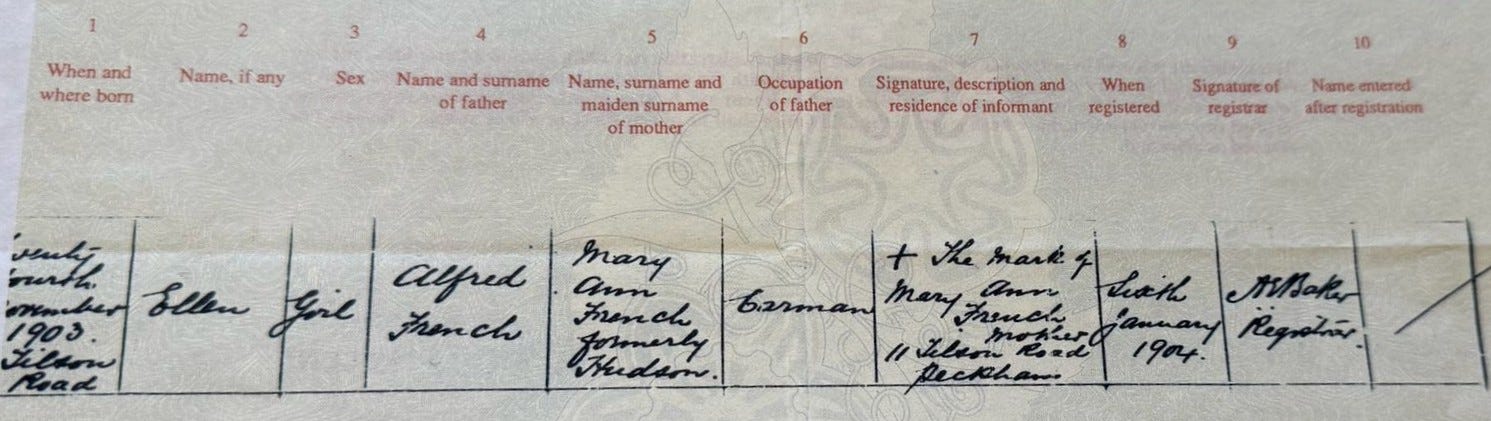
Above is a copy of Granny G’s birth certificate. Her mother was listed as Mary Ann French, formerly Hudson and her father as Alfred French. They had married on 17th August 1890, when Mary Ann was 18 years old and Alfred the ripe old age of 23.
Dad also found an older sibling - a brother called Alfred Thomas French - born in 1891, almost exactly a year after his parents marriage. He would have been 12 years old by the time Gran was born. He’s also proved to be a mysterious character - more on that in a later post.
They kept digging.
In the 1901 census - completed two years before Gran was born - he found her mother. She would still have only been in her late 20’s. She was listed as living at 11 Tilson Road - the address later used on Granny G’s birth certificate - with Grans older brother.
But… and listen it’s a big BUT… now she was listed as a widow. So the man named on Granny G’s birth certificate simply couldn’t have been her father - he’d been dead for at least two years. He was a ghost.
We haven’t been able (as yet) to find out what happened to Mary Ann’s husband, Alfred French. Dad found the death certificate of a man with the same name who died of pneumonia and cardiac failure on 8th May 1899. However, the age is off by a couple of years. The address doesn’t seem to fit. So it’s very unlikely that he is actually our Alfred French. Another mystery to solve.
So who was her father? We don’t know. And it’s unlikely that we’ll ever find out. But going by the 1901 census, and her mothers status in those records as not only a widow but also as head of the household, we’re almost sure that it wasn’t Alfred French and yet that was the name her mother gave when she registered Grans birth on 6th January 1904.
We have to assume that her mother was trying to make her look legitimate. But it seems that at some point her efforts came to nothing. In later workhouse and school records Gran is recorded as illegitimate. So someone, somewhere along the line, worked out that there was an ‘error’ on her birth certificate.
You can understand why her mother did what she did - for her own sake and for her child. Being a single mother, or carrying the stigma of being an illegitimate child, in 1903 was an unimaginably awful predicament when we try to understand it from our perspective here and now in 2026.
Her mother would likely have been shamed, humiliated, and even shunned. And things wouldn’t have been much better for Gran, when she grew up, as an illegitimate child.
Single mothers often formed the poorest sector of society. Finding work was close to impossible. And they frequently suffered from malnutrition and had limited access to healthcare. For some their last resort was prostitution and selling their only remaining asset - their own body.
Single mothers were also sometimes forced into the workhouse…
Workhouses were where the neediest in society had to perform hard physical work to get compensation in the form of the most basic food and shelter. They were the primary method of state-mandated welfare for the poor. But often you still had to prove that you were worthy of being given this support. And going into the workhouse changed your legal status, for example removing your right to vote (obviously only applicable to men at that time).
Those living in such places were called inmates. Inmates wore uniforms, followed strict rules, and were under the control of a master and matron. And yes, these were essentially prisons. The poorest people of society were punished for being poor.
Inmates couldn’t leave of their own free will and had to request permission to go out, even for short periods, for example when they went out to search for work. If one person in a family left the workhouse then they all had to leave. If you were elderly, sick, disabled, (a single mother), or were simply unable to find work in London at that time, then you could end up in the workhouse.
On the 1st October 1908, Gran, her mother, and her older brother are recorded as entering the Gordon Road Workhouse - run by Camberwell Board of Guardians. Gran was still a couple of months away from her 5th birthday.
We don’t know why they ended up going into the workhouse that day. Was it simply a last resort as her mother had no money? Were they forced in there because someone found out that Gran was illegitimate? Or was it something else?
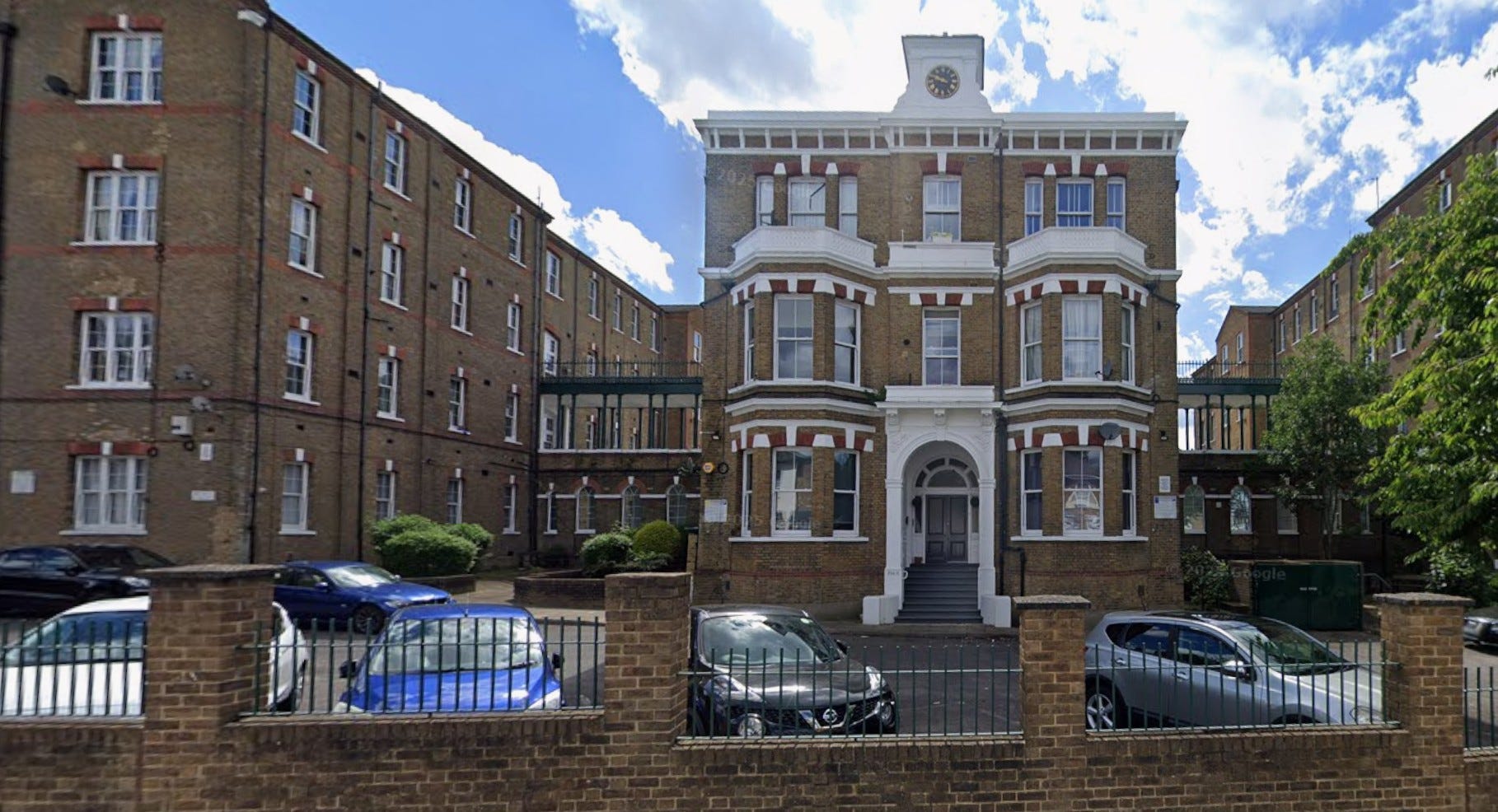
The Victorian buildings that were Gordon Road Workhouse as they look today after being converted into residential flats. Built in 1878 to house around 700 able-bodied inmates who paid for the roof over their heads by performing hard, physical labour each day. Men had to break stones or chop wood, while the women did laundry, cleaning, or kitchen work. The workhouse was built in the grounds of another building - Nazareth House - which had previously been a convent. Could that have been inspiration for the family fairytale that Gran was dumped on the steps of a nunnery? Image credit: Google Street View
Children had previously lived in the workhouses, in addition to adult men and women who were segregated in different wings. Families were split up as soon as they entered. But the The Children Act of 1908 (the very year Gran and her family went to the workhouse for the first time) was part of the changing landscape of child welfare, providing legislation to remove children from the harsh workhouse environment.
The following day, after they entered the workhouse, rather than being moved to a home for children the records show that Gran was admitted to Camberwell Workhouse Infirmary. Located just over a mile from the Gordon Road Workhouse where her mother and 17 year old brother remained and attached to another workhouse also run by the same Board of Guardians. That hospital would become Camberwell Parish Infirmary in 1913 and in 1948 it was renamed once more to St Giles’ Hospital, which continued to serve the community on that same site until it closed in 1983.
Gran would remain in hospital until she was discharged on 8th December 1908 and taken out by her mother.
We don’t know why she was in hospital for over two months. Though we are continuing to try and find out. Could it have been something to do with her deafness? Was it scarlet fever which was still running rife in London in 1908? Was it some other childhood ailment?
It’s a strange coincidence that scarlet fever is caused by the bacteria Strep. pyogenes, the same bug that caused my necrotizing fasciitis and tried to kill me by eating its way through the flesh of my left leg and abdomen. If you haven’t read that story then start here:

Within a few days of her release from hospital, on 13th December 1908, Gran is recorded as entering the Newlands home for children - one of many also run by Camberwell Board of Guardians to look after more than 600 children in their care. In the vast majority of cases children who had a (often single or widowed) mother recorded had lost her as she had entered the workhouse and just a handful had a mother in an infirmary or asylum. Only around a quarter of the children in care in Camberwell at that time were in fact orphans.
Gran would stay at Newlands for five months, until 22nd May 1909, when she was admitted to hospital again. Once more she was there for almost two months and was ultimately discharged on 17th July 1909. Could it indeed have been scarlet fever, that had resulted in rhematic fever, which put her back in hospital? Or was it something totally unrelated to the reason for her hospital stay at the end of the previous year? We don’t know, but I definitely want to say ‘yet’.
Once she got out of hospital the second time it seems she then went back to living with her mother at a couple of different addresses. Then almost a year later on 7th June 1910 she went back to the Newlands home for children for a few days.
We don’t know exactly what happened in the next few months. But we do know that on 4th October 1910 she was transferred to the Royal School for Deaf Children in Birmingham. It would have been a little over seven weeks before her seventh birthday. She was just a little girl. Removed from everything and everyone she’d ever know.
Along with her school admission record there’s a note - “no contact with mother to be permitted”.
To be continued.
If you liked this post then I’d love it if you would click on the heart and add a comment about what resonated for you – it means a lot to me to hear from each of you.
In case you missed it, I published my book - Hold My Hand: A Journey Back to Life - here on Substack last year. If you’d like to read it then you can find each chapter by clicking HERE and it will take you directly to the webpage dedicated to the book where you can read or listen.
If you would also be kind enough to share it I would be eternally grateful as it will help more people learn about these deadly infections. Maybe one day that knowledge will save a life.
Thank you!
Wow that made me cry so sad Jacqui ! How brilliant that you are doing all this research , it’s absolutely fascinating! How people were treated back then ! As a single mum myself, through no fault of my own, what would have happened to me back then. Makes me shudder.
It’s so interesting going back to see how your family lived, but what strength they must have had and such hard lives. A sad story, thank you for sharing it Jacqui.