
CHAPTER 14. Hold My Hand
Hold My Hand: A Journey Back to Life

If you missed the previous chapters of Hold My Hand: A Journey Back to Life then you click here to find them all - Hold My Hand - The Book. Want to know more about me? Oops! I forgot to introduce myself… And if you’d like to learn more about necrotizing fasciitis aka flesh eating bacteria then read this post… NECK-re-tie-zing FASH-e-i-tis... Say what?!
As always - thank you for reading or listening!
“If you really understand hand-holding — what it is and how it has its effects — you begin to understand just about every single facet of what it is to be a human being… It expresses all the things that we are for each other.”
James Coan, Clinical Psychologist and Director of the Virginia Affective Neuroscience Laboratory at the University of Virginia.
I always experience a little pop of excitement when I get to that part of a book where the reason for the title becomes obvious. I feel like it connects me more closely to the author and what they were thinking as they wrote. (Yes, readers, we have reached that point.) It’s time to pull back the curtain – this is the reason that my book has this particular title.
I’d never been a big hand holder until I met Kim. There’s something so wonderful in having my little hand lost in his big one. We posted a picture on Instagram a couple of years ago with our thumbs side by side. His giant size and mine looking like the thumb of a little kid. If you compare our little fingers the difference is even more startling and I’m down to doll size!
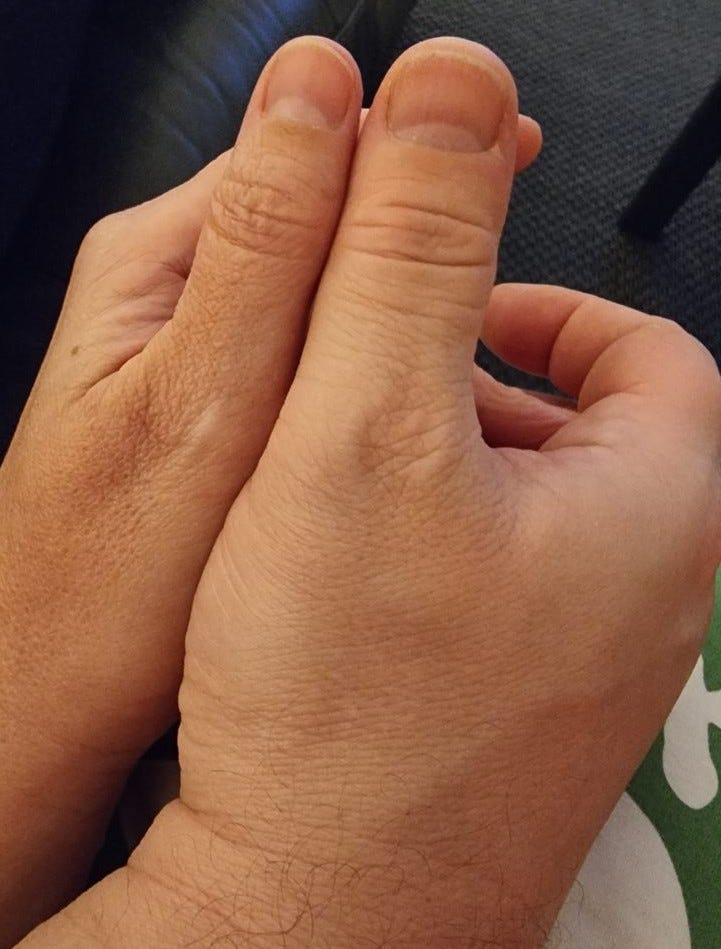
Image caption: ‘that’ picture of our hands side by side.
We hold hands when we walk the dog. We hold hands when we’re sat on the sofa – though the scale of the latest one makes that harder than it used to be. We lie in bed and hold hands. Sometimes we even sleep holding hands. And whenever he can see that I’m having a hard time he’ll grab my hand or pull me into a hug.
As a child I was never interested in holding hands – Mum might correct me, but I have little memory of holding hands with her or with other family or my friends. I have repeated told people that I have my own central heating. I seem to always be much warmer than those around me, especially when it comes to my hands and feet. I’m the last person to put on gloves and even the thought of thick wool socks or fur lined boots in winter appalls me. As long as there’s no snow on the ground I’ll always be walking around in flip flops or Birkenstock sandals. If I get cold, then you can guarantee something’s wrong with me.
Holding hands is special and the effect it has on you isn’t just psychological, it’s physical too (1). Research has shown it not only soothes and calms your body, but it reduces blood pressure and perceived pain, while also softening stressful experiences. It has the greatest effect when you’re holding your hands with someone you love, but it also seems to work if you hold a stranger’s hand.
Think of how small the palm of your hand is compared to the rest of the skin all over your body. Yet your palms have 15% of the sensory nerves related to touch in your entire body which is disproportionately high. As a result, your hands can tell the difference between a multitude of things, be it touching another person’s hand, stroking a pet’s fur, or putting your hand in a bowl of jelly.
And there’s more. Other studies have shown that you can even identify another person’s emotions, such as gratitude, disgust, happiness or fear, just by looking at their hands without even seeing the other persons face. Amazing, right?
Our hands are integral when it comes to our experience of the world. Yet we take them for granted. We never consider them not functioning, especially in their entirety. We’ve all experienced a cut on a finger, a bump on the hand, or perhaps even a broken bone in the hand or wrist. But for most of us that’s the worst we’ll endure when it comes to damage to our hands. It’s another thing all together when your hands don’t work at all – even for a relatively short time.
I tend to have nightmares. It’s something I’ve experienced since I was a child. I can remember lying in my bed and screaming for my parents to come and save me from whatever was frightening me and yet no sound came out. I tried to scream harder. I couldn’t do more than a little squeak. Of course, I wasn’t aware that I was dreaming – it felt so real – until I opened my eyes.
I also have plenty of tales of finding my parents as skeletons lying in their bed, being grabbed by the neck and wrenched backwards out of an open second floor window, and that old favorite of being chased by an invisible, yet incredibly scary, boogey man or monster. Some of these dreams fade quickly in the cool light of day, but others are still clear in my memory many years (and sometimes decades) later.
These days I have fewer bad dreams. Less stress and a more relaxed life have helped. But sometimes, just sometimes, Kim wakes and can hear my squeaking, feel the tension in my body, and he knows I’m lost in a nightmare. The solution? He gently puts his hand flat on my back. The warmth of that human touch wakes me just enough to leave whatever unpleasantness is happening in the dream and soothes me back into peaceful sleep.
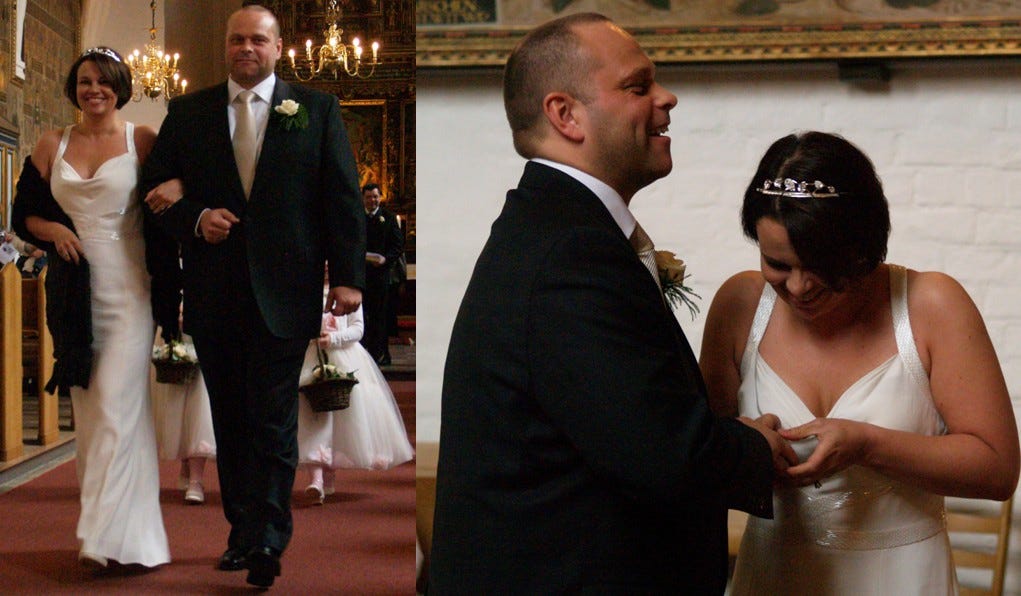
Image caption: we did a lot of hand holding on the day we got married - 22nd March 2008. We also had a good laugh as I tried to wedge Kim’s new wedding ring on to his generous sausage size finger! And yes, I got his approval before writing that. :o)
“Can you hold my hand?” I still hear Kim’s words echoing in my head. His voice becoming more and more desperate as he spoke to me that evening in the ICU. I don’t even remember if I could feel the touch of his hand on mine. In my head I think I could but maybe that’s fiction and I’m just hoping that I could feel the comfort of his hand on mine at a time when I needed it most. I know how soothing and reassuring it would have been for me – consciously or not.
I couldn’t hold Kim’s hand that day. Nor the next as I gradually awoke after that fourth operation. As I’ve said my hands didn’t work – they just flopped around on the end of my arms. I had no control over my hands or fingers. It makes my hands ache right now even thinking about it.
For Kim being able to hold my hand was so important to him (and it was for me too). A way to demonstrate that we’d never let go of each other again. A way for him to convince himself that I didn’t want to leave him. A way to stay connected. A way for him to gain a little confidence that I would indeed get better.
Looking back, I continue to be surprised that the nurses and doctors didn’t even seem to notice that I couldn’t use my hands. Many saw specific incidents that made it obvious. But they certainly didn’t ask. Or even check if I had a problem.
There was that ice lolly incident after the 4th operation. Other instances when I couldn’t open those little pots of pills. Couldn’t operate my own phone. And of course there were also my twitching fingers that couldn’t pick up a glass of water however hard I concentrated. Why did the nurses not notice? Perhaps they didn’t want to? Maybe they thought it was someone else’s problem?
Even when I got to the new ward the nurse didn’t hesitate to feed me those first yogurts. They too probably thought I was too exhausted from the operation or too weak to feed myself after having been in a coma for a week.
I’m not sure exactly when I started to realize my hands weren’t working. I don’t remember being scared. Or even thinking about whether the damage could be permanent. I was busy just trying to even vaguely comprehend what had happened to me.
My hands became a way for Kim to track my recovery. A barometer that showed the level of my returning strength and spirit. Checking, in his own way, that everything was going in the right direction.
Each day, once I was awake, he would ask me to hold his hand for his daily check. Every time I would put my hand in his and try to squeeze. Looking back, I realise that he was being kind and telling me how great I was doing even if he felt only the gentlest of pressure from my hand. I was convinced that I was squeezing hard enough to crack nuts.
He’d bring me little challenges. I’d missed all of Christmas and the prerequisite gift giving at home. So one morning he and Mum brought in a big bag of Christmas gifts so that I could open them. It certainly filled some time to keep us all amused. But it was such hard work. I felt like a toddler would have done so much better than me in getting through the tape and paper. Sometimes (in fact most of the time) it all defeated me, and I had to let Mum or Kim take the gift and finish opening it for me.
As the days passed in hospital I got a little more movement back in my hands each day. I gained a little more control over how they moved. And they became more responsive to what my brain was telling them to do.
It probably took two or three days for the coarser motor skills to come back – being able to control larger movements. It started with being able to hold a spoon to feed myself a yogurt or drink a protein shake. With concentration I was able to pick up a cup again.
Finally, I could pick up my phone. Sliding my finger around the screen several times before I could get my fingerprint in the right spot to open it. My replies started with just emoticons. Then a single word. Gradually with practice my messages got a little longer – though I had to delete almost as many wrong letters as keep the right ones. It was exhausting but also exhilarating to be able be a little independent and feel connected to the world outside my hospital room again.
During those days directly after ICU my hands also started to look different. All the skin on my fingers dried and cracked. We tried putting moisturizer on my skin. Rubbing it in multiple times. But nothing helped. It just dried out again. Ultimately an entire layer of skin peeled away to reveal fresh skin underneath. It was almost like my hands were being reborn.
I’m still not exactly sure of the root cause of the problems with my hands. Perhaps it was a result of the infection, my poor circulation because of my incredibly low BP, some kind of other effect from the sepsis, or something else.
After hours of digging and a lot of dead ends a friend, who is a doctor, did find references to something called critical illness polyneuropathy (CIP) – impairment of the nerves - and critical illness myopathy (CIM) – impairment of the muscles. These both affect patients admitted to ICU with sepsis and septic shock.
It’s estimated that as many as 70% (a significant majority) of patients with sepsis develop CIP (2). I’ve not I had the chance to ask a relevant doctor, but I’ve been through my medical journal and can’t find any reference to them considering that I might have been affected by CIP. Perhaps it was this condition that affected my hands, but it will remain another unknown on a long list of mysteries.
People assume that my hands are fine now. If I’m honest I generally go ahead and let them think that. Everyone I’ve told about what happened has such a hard time even attempting to wrap their heads around the fact that my hands didn’t work. So I don’t want to complicate matters.
Mostly my hands are better. Though in some weird way they still feel a little alien. As if they’re not my hands at all. But they work and I’m incredibly thankful for that. Over the months my fine motor skills, that help you do the little fiddly things like threading a needle or pressing a small button, gradually returned.
But my hands are different. They get tired more easily. And when I’m exhausted, they have this strange tingle and ache – like a very soft pins and needles feeling. I have less grip strength than I had before (yes, I know I need to buy one of those little hand exerciser devices!).
I also continue to find other things that still create small challenges for my hands and especially my fingers. While typing the thousands upon thousands of words for this book I’ve found out that my fingers still sometimes have a bit of a will of their own. They don’t always exactly follow the orders from my brain. Spasms and twitches happen that I wouldn’t have recognized otherwise.
A finger will be heading for the right letter on my keyboard and then suddenly twitch – left, right, up, or even down (there’s no pattern) and it will hit a different letter entirely. Needless to say, that sentence said ‘hot a different letter’ in the first version I typed as my finger twitched right. It means that spell checker gets a bit more of a workout than it did in the past.
I was on the clumsier end of the spectrum before this whole thing happened and the hands issues definitely haven’t helped. I certainly feel that I’m more prone not only to dropping things and knocking things over, but also more generally in bumping into things. There again after all of the trips, falls, and other little accidents that I’ve had all my life Mum may well disagree that anything has actually changed.
I so appreciate that the function in my hands came back at all. I’m aware that there’s a significant number of patients with NF, and also more broadly with sepsis, that aren’t so fortunate. They must live with various levels of limb amputation that was required to save their lives and, in some cases, have no hands at all.
I count myself as lucky and I’m happy to make the best of what I have. Kim and I will still be holding hands, at every opportunity, when we’re old and grey – well, older and greyer than we are now!
REFERENCES
The impairment of small nerve fibers in severe sepsis and septic shock – Critical Care 2016 – Hubertus Axer et al.
If this post made you feel something then I’d love it if you would click on the heart and add a comment about what resonated for you – it means a lot to me to hear from each of you.
If you would also be kind enough to share it that will help more people find Hold My Hand and learn more about these awful infections. Maybe one day that knowledge will save a life.
Thank you!
If you missed any previous chapters from the book then you can find them easily on my website – click HERE and it will take you directly to the webpage dedicated to the book where you can read or listen to any previous chapters that you might have missed.
Every THURSDAY I’ll continue to share my ‘book in parts’ - Hold My Hand: A Journey Back to Life - chapter by chapter. I’m so excited to finally share it with all of you.
So emotional Jacqui. Kim sounds amazing, so glad you had such incredible support.
I love hand holding but have no ones to hold 😒 not even the kids now they are older. One day maybe😊
I'm so lucky - he's wonderful and I love him more every day. Just realised that we've lived together for 20 years this summer. I have everything crossed that you find one of the good ones too. 🤞🤗