
CHAPTER 18. Better Than Before
Hold My Hand: A Journey Back to Life

If you missed the previous chapters of Hold My Hand: A Journey Back to Life then you click here to find them all - Hold My Hand - The Book. Want to know more about me? Oops! I forgot to introduce myself… And if you’d like to learn more about necrotizing fasciitis aka flesh eating bacteria then read this post… NECK-re-tie-zing FASH-e-i-tis... Say what?!
As always - thank you for reading or listening!
“I am better than I was yesterday but not as good as I will be tomorrow.”
Unknown
TOUGH vs STRONG
The whole NF experience left me feeling betrayed by my body. The work I’d put in over the years to invest in my physical health and to be ‘fit’ seemed to have been for nothing. Yet my gut told me that all that effort may well have played a significant role in my survival.
So I went hunting for data and evidence and my suspicions were confirmed that my level of fitness really would have an impact in this type of situation. Not only in terms of contracting an infection like this in the first place, but also in terms of my chances of living to tell the tale.
It’s always hard to find data specific to NF as it is so special. But a long-term Swedish study looked at a group of patients that had experienced a wide variety of infections – including soft tissue infections such as NF (1). They showed that exercise did seem to reduce the chances of getting a major infection and sepsis, being admitted to ICU, and death.
The exercise effect was shown to be “dose-dependent”. In other words, the more you exercised, the lower the risk of getting and dying from one of these infections. As little as an hour of walking or exercising a week made a positive difference. Yes, I really said that, as little as 60 minutes over the course of seven days. But take that up to five hours a week and they saw an even greater positive effect.
Another study suggested a similar pattern for patients with COVID infections (2). Physical activity before infection seemed to reduce both the disease severity and the risk of dying for these patients. This was especially true when the person had been doing more than 150 minutes per week of moderate physical activity or more than 75 minutes per week of vigorous activity.
Yet it’s not just about surviving – it’s also about how long it takes you to recover. None of my recovery from NF felt particularly fast to me as it was longer than anything else I’d experienced previously. But I’m very much aware that my physical recovery was significantly shorter and much more complete than many other NF patients. I’m one of the lucky ones.
One of the words that several people have used to describe me during my recovery – including Kim – is ‘strong’. According to the Collins English Dictionary someone who’s ‘strong’ is healthy, with good muscles. They can move or carry heavy things or do hard physical work. They’re confident and determined – not easily influenced or worried by other people.
But being strong is just one perspective of how I have handled what happened to me. I didn’t feel that particular word said enough. Instead, I tried looking up the definition of ‘tough’. A person who is tough is so much more than just strong. They can also tolerate hardship, difficulty or suffering. They’re feisty, self-confident, unyielding, hard as nails, resilient and even badass. I love that description. Now all I needed to do was live up to it!
As part of my physical recovery I needed a goal. Something to work towards. In recent years Kim and I completed the annual Copenhagen Swim – a 2km (a mile and a quarter) open-water event that happens in the city on the last Saturday in August – a total of four times. As soon as I was back in the pool I knew that participating in that swim again was my target. It would be almost exactly eight months after they’d woken me up from my coma. In my head the swim would be proof that I was physically ‘better’ and that my body was no longer letting me down.
I put in the laps. I did my best to build my stamina. But by the time that August rolled around I knew in my heart that I wasn’t where I needed to be. My body just wasn’t there yet. Previous experience reminded me of just how hard it was to swim that distance in choppy open water, with hundreds of other swimmers, compared to the placid calm of the local pool. And that was when I was truly ‘swim fit’. Add to that I’d have to do it alone as Kim wasn’t up for it this time around. But I wasn’t about to give up. Did I mention that I can be stubborn past the point of reason?!
On the day I’m still not sure how I managed it. My courage and bravery were stretched to their limits just getting in the water at the start. I almost gave up 100 times. Even in the first 200 meters I remember looking longingly at the lifeguards on their paddle boards and imagined swimming over to take a break and to admit I was done before I’d even really started.
As I swam out of the main waterway and into the canals around our parliament building I kept looking at the various sets of steps that led out up the canal wall and imagined my feet taking me out of the water.
As Kim walked the course on the path above me his unwavering support kept me going. Calling encouragement and kind words to me. I could not give up. I would not fail. It was not an option.
I’m still not sure how I got through it. But I did. I’ve never done anything so physically hard in my life. It took guts. It took perseverance. I had to dig deep in my soul. It took every ounce of my resilience. It took everything (and I mean everything) I had to complete it. After all that I know without question that I’m bloody ‘tough’.
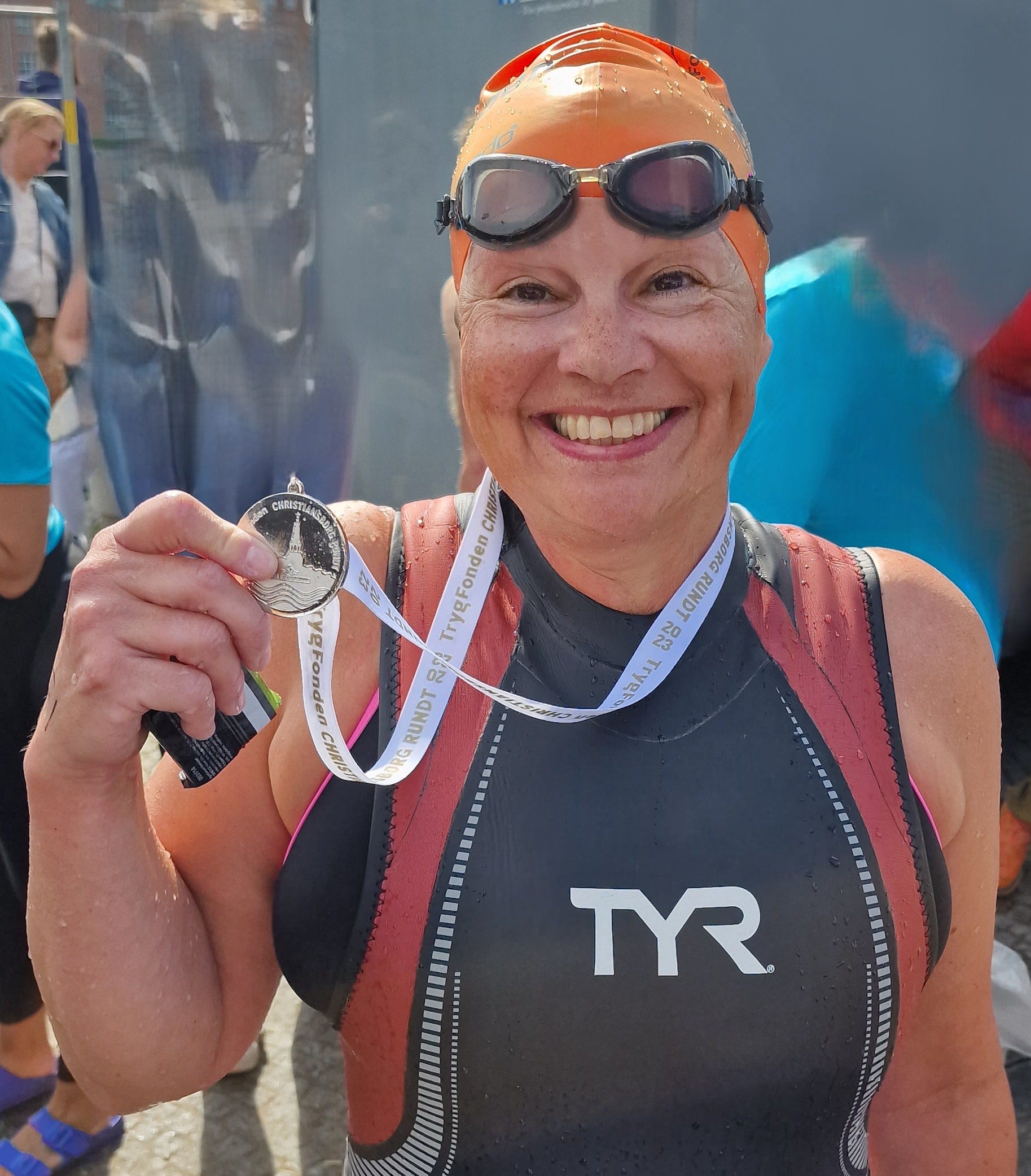
Image caption: my beaming grin on Saturday 26th August 2023. Just eight months after waking up in intensive care I swam (for the 5th time) the 2km Copenhagen Swim. Just check out that smile of victory! I completed it once more in August 2024 and have now hung up my wetsuit. I’ll stick to the pool for the foreseeable future. But I’ll never say never again!
PHYSICAL IMPERFECTIONS
“Scars are a truly beautiful thing. Yes, they can be a little ugly on the outside, but scars show that you’re a survivor, that you made it through something, and not only did you make it through, but now you’re stronger and wiser …”
Kyle Carpenter
A snapshot in time in my minds eye. The moment I stood in our bathroom on the day I came home from hospital. The shock of seeing my ‘new’ self in my ‘old’ world. Unable to process that the person looking back at me was indeed me. It’s impossible to comprehend how much your body and physical image can change in the space of only two weeks until you experience it.
It took around three months for my open wounds to heal and become scars. The impact of the infection slowed my body’s healing abilities. And so much tissue had been removed that what was left was stretched thin in some places and the local blood supply wasn’t great which also contributed to delaying the healing process.
Kim became a master at redressing my wounds and each time would take a picture so that he could compare if they had healed a bit in the few days since we last looked at them. You can imagine that they’re not pictures we particularly want to look at again.
I hated looking at my open wounds – terrified every time that we had to remove the dressings that I would see some sign of an infection starting again. And equally desperate for them to look like they were healing so that I could get back to some version of normal life and the luxury of a shower.
Each day seemed longer than the last as the healing process moved so slowly. Every minute dragged past. Now looking back if feels like such a short time that went in a flash. Yet it felt like forever when I was going through it.
Now the scars on my body tell my story. Not only the story of my journey with NF, but also of many other events in my life. The knee scar after falling in the garden playing chase with family friends when I was five years old. The scar on my lower back from that surgery. The scar on my shoulder that looks as if someone tried to cut my arm off but relates to three surgeries after my cycling accident at university. And a variety of scars from the suspect moles that I’ve had removed over the years. To name only some of them.
My scars are rarely invisible as I’m ‘keloid’. When I’m cut open I have a genetic predisposition to sometimes produce thick raised scars. Dad was the same. Definitely not pretty. They’re not harmful to your physical health. But they look gnarly.
I remember the first time that I went back to the pool – my wounds finally sealed enough for it to be safe. Undressing in the changing room I felt like all eyes were on me. In Denmark we don’t have individual cubicles to hide in. I was out in the open in one large (women’s) changing room. I was convinced that everybody was looking at my scars and wondering what on earth had happened to me.
I knew that in reality people were too busy living their own lives, too lost in their own thoughts, to even look at other people in that changing room. But there’s a few. There’s a few who I caught staring at me. As soon as I looked at them, they looked away. Embarrassed at being spotted.
I told myself that I wasn’t bothered about other people seeing my scars. And as the months have passed that’s become closer to the truth. It’s taken time (and more plastic surgery) to improve how they look.
But when I was first back in the pool and back out ‘in public’ I think I was relieved to hide them away under cycling shorts as well as a swimsuit. It was just another way that I tried to force what had happened to me into the past.
There’s also the issue of the sensations when the scars and the surrounding skin are touched. I have areas that are totally numb – they still have no sensation as the relevant nerves have been cut. Some areas have some sensation, but it’s not normal and verges on unpleasant when they’re touched. Then there are also areas that are now hyper-sensitive. I know over time they’ll gradually settle down in different ways, but it takes yet more months and more likely years.
“They call it kintsugi. The pot is shattered, then carefully reassembled with a resin mixed with gold. It symbolizes how we must incorporate our wounds into who we are, rather than try to merely repair and forget them.”
David Wong
Kintsugi is the Japanese art of ‘golden joinery’. Think of a shattered bowl, broken into a multitude of pieces, that is then repaired with care, thoughtfulness, compassion, and sensitivity. It’s put back together (fixed) with a resin that is dusted or mixed with powdered gold, silver, or even platinum.
The philosophy of kintsugi is that the value of an object lies not in its beauty, but in its imperfections and its history. These should be celebrated, not hidden. Its new form is even more beautiful than the ‘perfect’ original.
It’s a wonderful metaphor – I am that bowl. Having been thrown up in the air and shattered into a million pieces as I hit the floor. My recovery has been the process of putting myself back together, with a lot of help from those around me. Every day I see glimpses of those golden repairs – my scars – when I look at my leg or at my abdomen.
THE MISSING TATTOO
I never realized that my abdomen was my favorite part of my body. Weird I know – I’ve heard other people talk about many different parts of the body that they’d class as their favorite, but never that one.
About 25 years ago, when I gave up on IVF and acknowledged that I wasn’t going to be able to have children of my own, I had a tattoo etched into my skin just below my navel. A ‘v’-shaped, abstract, branching design that was probably 12cm (4 or 5 inches) across and 5cm (2 inches) high.
It wasn’t particularly beautiful or refined – no surprise there as it was done by a skinhead with three and a half fingers on his right hand, in a little tattoo shop under some railway arches. There was a baseball bat behind the door and brass knuckles lying on the desk. I kid you not! But I loved that tattoo. It was a symbol for me that I was ready to look to the future after a challenging period in my life.
When they cut into my abdomen in that first operation, they opened up a wound that ran about 15 cm, so six inches, from my navel and down – right through the middle of my beloved tattoo. When they closed it up two days later they clipped it back together with vicious-looking metal clips. But the surgeons took the time to realign the two segments of the tattoo so at least it didn’t all look wonky!
I hated those metal clips. The skin around them always looked irritated. One area kept weeping a yellow fluid. And when the clips were removed the wound hadn’t healed as it should. Some areas were OK, but another part hung open. The nurse tried to tape it together. The tape fell off within an hour or two. It simply didn’t heal.
The hole grew. I ended up with what’s called a fistula – a hole into my abdomen that was three centimeters, over an inch, deep at its worst. It was sore. It continued to weep. It scared me to death that some other bacteria would get in through this little cave. It took months, and lots of trips to the GI wound clinic, to heal.
That little area took as long to close and seal over as the much larger wounds on my leg. And the nasty looking scar was made worse by a big dip, where the fistula had been, that looked horrible.
Our first little break away from home was four months after I came out of hospital. A few relaxing days away in the sunshine. An opportunity to get away from our real lives.
I remember arriving at the hotel and looking around at all of the women by the pool in their bikinis. I was devastated. It hit home that I was never going to physically look that good again.
It wasn’t just the scar down the center of my abdomen. From the front I looked relatively normal - slim waist and slim hips. But when I turned side on it was another story entirely. I had this weird pot belly that stuck out and it wasn’t just a little bit. I looked like I had half a basketball protruding from my stomach.
At first, when I came home from hospital, I’d assumed that it was related to all the fluid that they’d pumped into me in the ICU. I thought over time it would go away. It didn’t.
I became fixated on exercising my stomach muscles every day to try and flatten them out. But nothing changed. If anything, it got worse.
It got me down. Really down. Much worse than the deformities and lumps and bumps I had on my leg. It changed how I dressed. It meant that I wouldn’t wear anything that was too fitted. Nothing that showed off my belly anymore. I had to wear loose clothes – anything that hid that ugly protrusion.
It took me almost a year to work out what was going on. I came close to going to see our family doctor about it, but once again Google was my best friend. It seemed that when they’d closed up my abdomen they stitched the skin together, but they hadn’t stitched my abdominal muscles back together that they’d also cut through. So the central muscles just flopped – pushed out further by my guts and everything else in my abdomen.
Lying on my back on the floor, I could push the skin down and stick three fingers into that vertical space between my muscles. It felt like I was putting a hand into my insides. Well, I was basically doing just that.
Medically it’s called ‘diastasis recti’ and it literally means a split in the centre of those abdominal muscles. It affects some women after pregnancy and in cases like mine it also affects people after abdominal surgery when the muscle layer isn’t sewn back together.
I found out that I didn’t need to live with it. It needed to be repaired not purely for the sake of my vanity, but also because my back needed the support of those same muscles. That’s how Dr Lovely, my plastic surgeon, became part of my medical team.
Going through additional surgeries by choice wasn’t easy. The thought of someone cutting me open yet again filled me with equal measures of dread about the pain and infection risk. But it also gave me a rush of excitement at the possibility of being able to have my body look better, and also feel better about it too.
I was so focused on her repairing my abdominal muscles, and reducing the risk to my back, that I totally missed what the rest of the operation would entail. I knew she would open me up horizontally from hip to hip and go under the skin up to my ribs and then work her way back down stitching the muscles back together on multiple levels.
But I totally missed that they’d also do a tummy tuck. That means that they’d pull the loose skin downwards and cut away any excess before they sewed up that hip-to-hip incision. They’d cut around my navel and reposition it in that new taut skin.
When I woke up from the surgery I had never expected to be as sore. When I got out of bed I could only walk hunched over like a little old lady. A slow shuffle and a lot of praying that I wouldn’t sneeze any time soon.
The new wounds were covered by an elastic corset holding everything in place that I’d be wearing for the next three months. Multiple times the nurses came to open the corset and check that the wounds looked OK. I saw nothing amiss. Ecstatic that the basketball was gone for good.
But it was only the following morning when Dr Lovely came to see me and opened the corset again that finally the penny dropped. My tattoo was gone except for a tiny little line (just a few millimeters long) that now disappeared into the new wound that was so neatly sewn up.
But that wasn’t all … My gnarly 15cm scar from my navel downwards was entirely gone! It was as if it had never existed. They’d pulled the skin down so much that all traces of that scar had disappeared along with that excess skin.
One part of my history had been erased and replaced with a new story.
Though my abdomen was on the right path my left thigh still looked like a shark had taken a chunk out of it. It was lumpy and bumpy with three pieces sticking out – the worst, known affectionately (not) as Mount Fuji as it was a similar shape, stuck out at least 4cm (almost 2 inches).
Not only did it not look pretty, it was also sore, sensitive, and achy. The only way I could get relief was to continue wearing a compression bandage 24/7. The only time it came off was when it was replaced by the tight cycling shorts that I wore in the pool and for the short time it took for me to shower.
As soon as Dr Lovely saw my leg during my abdominal surgery, she was already focused on that being our next project. She was on a mission to work more of her magic.
A few months after my abdominal surgery I was back in the hospital to quietly have what I hoped was my seventh and final surgery of this NF journey.
TIME TO LET GO
It’s natural after an experience like mine to want to hug things to your chest. Hang on tight to the things you know and that bring you some kind of comfort. There’s been so much thrown at you that you just need to feel safe with things around you, that you know and feel you can rely on.
But as time has passed, I’ve learned that sometimes you have to let things go that no longer serve you. Let them be part of your past. It’s time to move on.
As I’ve said, before my left leg was ‘fixed’, it was lumpy, bumpy and needed 24/7 support to hold it together and minimize the aching and weird sensations. As a result, I’d swum either in a swimsuit with legs (think of a less compressed version of the suits the female competitive swimmers wear) or I’d paired cycling shorts with a swimsuit over the top. Neither gives me the physique of those Olympic swimmers, but they did the job.
I was so acclimatized to swimming in shorts. And after swimming outdoors over the summer, I had an interesting two-tone tan – with the brownest knees and the whitest thighs. Not particularly fetching or flattering. Even after the wounds from the final plastic surgery to tidy up my leg had healed, I was still swimming in my shorts. They felt safe. But after a few weeks I knew they had to go. There was no reason to continue wearing them.
It was one thing to focus on my recovery or getting better, but one of the scariest things I have encountered in this journey is simply living. It terrified me that people expected me to now embrace life again. I still didn’t feel ready to stop hiding behind ‘being sick’ and accept that I no longer had an excuse to avoid living. Somehow letting those shorts go was a message to the universe that I was indeed ready to live again.
Finally the day came – I knew I had to push myself. If the shorts came home with me from the pool then they’d be back on the next time I went. It was time. The shorts were ceremonially dropped in the rubbish bin in the changing room. I said a fond farewell and thanked them for their service. I’d love to say that I didn’t think that I’d miss them one little bit, but if I’m truthful at the time I felt as if somebody had stolen my favorite comfort blanket.
The next time I went to the pool it was my first swim since 22nd December 2022 in just a normal swimsuit – more than 18 months. I had meant to go three days before but I kept avoiding it. Finding excuses. When I got there, I felt naked and vulnerable. It wasn’t as if people hadn’t seen my scars in the changing rooms and showers. But this was different. I was going out ‘in public’.
I slogged my way up and down the pool. Hyper-aware of the sensation of the water on my scarred leg – it felt strange having the water directly on my skin. Not unpleasant, but not particularly nice either. Even the scars on my abdomen seemed to tingle more than they had previously when they’d been covered by both my shorts and swimsuit. All the time I was thinking about people looking at me and all those scars.
As I finished my swim a woman in her twenties and her mother had just climbed the ladder out of the pool before me. Nobody usually talks to anyone that they don’t know at our pool. Most people even avoid eye contact. If you’re lucky, maybe you’ll manage to get a smile from one of the lifeguards and a “have a nice day”. But today was different. It was one of those (special) coincidences when the universe decides to help you in a time of need.
The young woman turned to me as I got out. “You’re such a great swimmer,” she said. I looked at her, taken aback. Not only does nobody normally speak to you, but they certainly don’t say anything like that. I didn’t know what to say. But I managed to blurt out my thanks and told her how much I loved to swim.
We walked over towards the changing rooms together. “How frequently do you come to the pool,” she asked. “I guess you do other sport too – what else do you do?” She gestured at my body. “You must do a lot as you look so amazingly fit.”
I couldn’t believe my ears. I was totally blown away. Tears pooled in my eyes. Her words meant so much to me. What were the chances of someone saying something like that to me on a day when I felt so utterly vulnerable? A day that felt momentous for me – a landmark in my recovery.
As I walked out of the pool into the sunshine I let tears run down my face. But I couldn’t help but smile as I took another little step forward in my journey back to life.
I’ll never be ashamed of my scars. I wouldn’t be the same person without them. I carry them with me as part of my story – they’re a map in their own way. I’d even say that I’m proud of them. They’re physical evidence of the battles that I’ve fought, and they prove that I won.
Over time they’ll fade, but they’ll never go away. And I don’t want them to. They’ll always be there to remind me that what happened was real and not a dream. They’ll remind me to live life to the full. Make the most of every day. And to be kind to myself.
WHAT IS ‘BETTER’?
Sometimes I ask myself: am I better? Is there any such thing as truly recovered? These questions run around in my head on a regular basis.
I feel as if I’ve had to ‘get better’ multiple times over the past two years. I’ve had to rebuild myself each time – each one giving me unique challenges.
First, there was my back operation and recovering from having four big titanium screws and a couple of metal plates inserted in my back.
Then I got NF and had the double challenge of recovering both mentally and physically.
Then there was the first of the follow-up operations to repair my abdominal muscles – some additional (planned) pain to take another significant step forwards. Even if it felt as if it took six months afterwards for me to be able to stand up straight again!
And finally, one more time – the recovery from the work done on my leg. I ended up with some extra inches of scars, but darn they’re neat. And the recovery was the quickest and easiest of the lot.
My recovery each time has never followed a straight line, but rather a twisting, bumpy path. There have been lots of ups and downs – little setbacks that have required me to work even harder.
But what does it mean to be ‘recovered’? Perhaps it means to return to a normal state of body and/or mind? Then again, I’d challenge you to define ‘normal’.
Perhaps it means becoming completely well again after an illness or injury. But what is ‘completely’? How do you know that you’ve reached that point? Do I say to people that I’m in recovery, that I’m recovering, or that I’ve recovered? Am I still getting better? But better than what? Am I ever going to be better?
In many ways I no longer care. I don’t mean that flippantly. I know that I’m permanently changed. Both physically and mentally, for better or worse. For me I think that recovery is based on achieving a state of balance between old and new. Everything I was before is still there in some form. It’s not gone. It’s not disappeared. It’s just a question of how I integrate the two together to become one again.
I’m still working on it, but I know that in the end I’ll be even better than before.
REFERENCES
If this post made you feel something then I’d love it if you would click on the heart and add a comment about what resonated for you – it means a lot to me to hear from each of you.
If you would also be kind enough to share it that will help more people find Hold My Hand and learn more about these awful infections. Maybe one day that knowledge will save a life.
Thank you!
If you missed any previous chapters from the book then you can find them easily on my website – click HERE and it will take you directly to the webpage dedicated to the book where you can read or listen to any previous chapters that you might have missed.
Every THURSDAY I’ll continue to share my ‘book in parts’ - Hold My Hand: A Journey Back to Life - chapter by chapter.
This is so moving . Thank u
Love the photo of you beaming with pride and looking super fit. Also love the metaphor of kintsugi- process of putting yourself back together. So much positivity in your story and journey. Very well done Jacqui.
Sue x