
CHAPTER 22. A Trip to the Deep
Hold My Hand: A Journey Back to Life

If you missed the previous chapters of Hold My Hand: A Journey Back to Life then you click here to find them all - Hold My Hand - The Book. Want to know more about me? Oops! I forgot to introduce myself…
As always - thank you for reading or listening!
HOW IS NF TREATED?
Just like so many things with NF there’s no definitive rule book when it comes to treatment.
You can be sure that there will be repeated aggressive surgeries to remove the dead, infected tissue. A NF patient will go through on average four operations, but depending on the scale of the infection it can be many more and in fact well into double digits (13,14). Surgeries are more frequent initially – at least daily – and then become more spaced out - every other day – and finally move out to longer intervals in-between. For once I feel I was almost ‘normal’ with my five surgeries over those first ten days.
You’ll also certainly have gallons of i.v. antibiotics pumped into your veins – selected to attack the specific bacteria involved.
And in many cases, you’ll be admitted to some kind of intensive care department in a hospital while they work hard to keep you alive – pumping other drugs into your system to keep you sedated and opioids to ensure that you’re pain-free.
Treatment protocols for NF haven’t really changed for decades (15).
THE HEALING POWER OF OXYGEN
I think most of us, including me, would think of diving accidents when someone mentions a hyperbaric chamber. These specialist pressurized chambers are best known for their use in the treatment of decompression sickness, sometimes known as ‘the bends’. It’s caused by gas, previously dissolved in blood or tissues, forming bubbles in blood vessels when a diver comes up from deep water too quickly. However, these chambers also play a role in the treatment of a wide range of illnesses and injuries, including serious infections such as NF.
We may think of this as a ‘modern’ treatment, but when I researched this section of the book, I was stunned to find out that hyperbaric therapy, initially with just pressurized air in a metal container, was first utilized as early as 1662 by a British physician called Henshaw (16). Though it was only in 1937 that hyperbaric oxygen therapy (HBO2T) was first used successfully to treat decompression sickness.
By 1955 HBO2T was being applied to treat the effects of radiation therapy in cancer patients. Soon after they also started to treat patients with burns and other conditions.
HBO2T is now known to potentially benefit a wide range of patients with:
Bubbles of air in blood vessels, such as decompression sickness.
Serious, life-threatening infections, like NF.
Wounds that have problems healing, like diabetic foot ulcers.
Radiation injury related to cancer treatment.
Accessibility to these chambers is limited as there are only a small number of them in each country relative to the size of the population.
Whether they are used as standard of care – in other words as part of the accepted medical practice for a particular condition or illness – also varies widely. In many cases it isn’t even standardized at the country level.
Though HBO2T is a well-established treatment for decompression sickness, it is far more controversial when it comes to NF. In the US it’s estimated that only 1% of patients with a NSTI receive HBO2T treatment as it is not a recommended by the relevant medical associations (17). But that doesn’t mean it doesn’t work.
In Europe we’ve taken a different position, and it is used more widely for NF patients as it is seen as a useful addition, if available, to the standard treatment of surgery, antibiotics, and intensive care.
In general, there are two types of HBO2T chamber. There’s a ‘mono’ unit designed for one patient where you lie on a table that slides into a clear plastic tube-shaped chamber. Or there’s a ‘multi-person’ unit – like the one where I was treated - designed to accommodate a number of seated patients or a single patient lying on a bed or trolley. These can look ‘submarine-like’ or larger chambers can be hard to distinguish from a large hospital room – only the small circular windows give it away.
Oxygen is delivered to the patients in a variety of different ways – in my case my ventilator was flipped over to pure oxygen. But for those not on a ventilator oxygen can be delivered through a mask over the face, or for seated patients, via a lightweight, clear hood that is placed over the head and sealed around the neck.
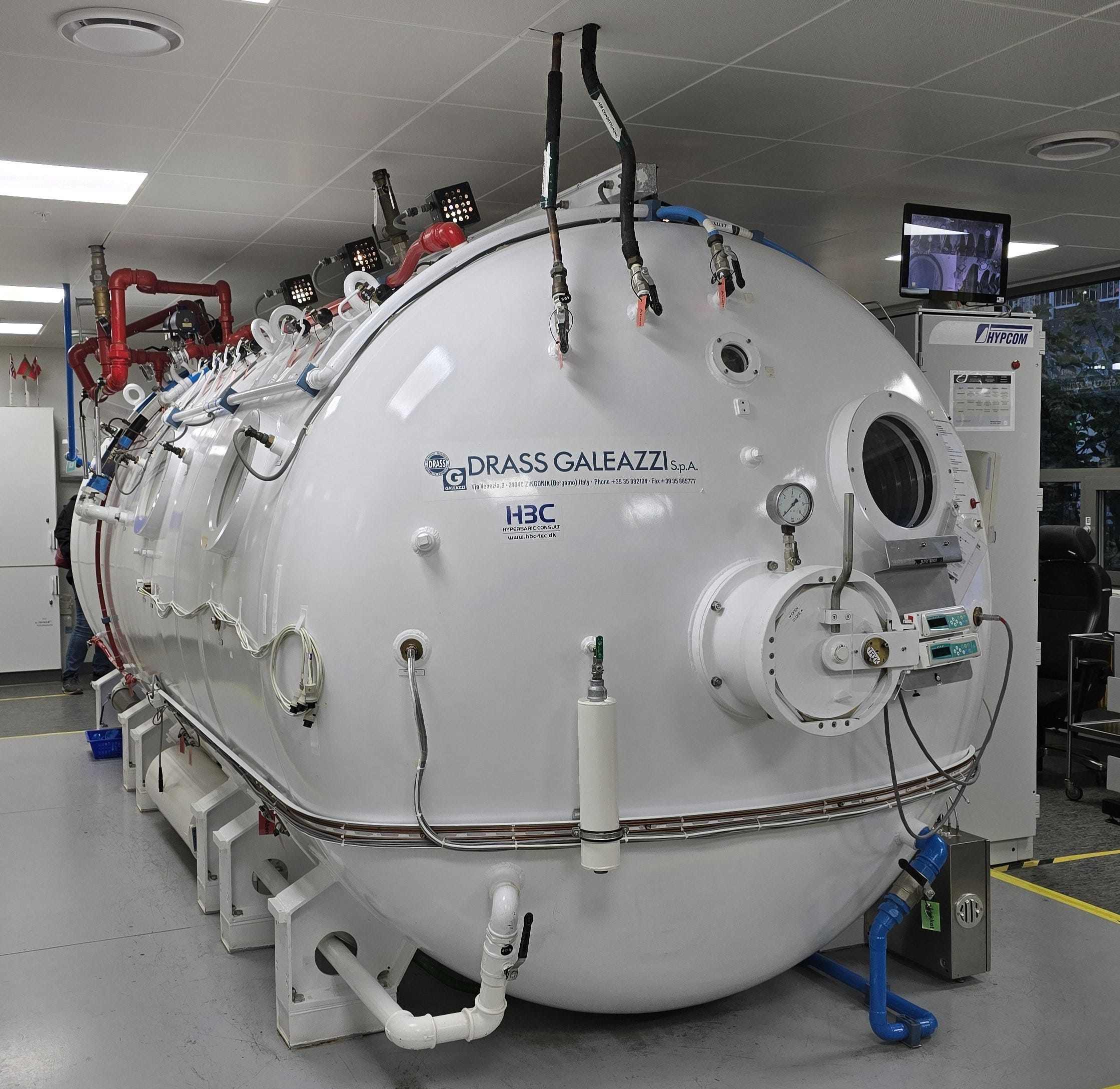
Image caption: from the outside the hyperbaric chamber looks like a small submarine with a lot of pipes around it. The entrance is at the far end via an airlock that then leads into the main patient chamber. My own picture.
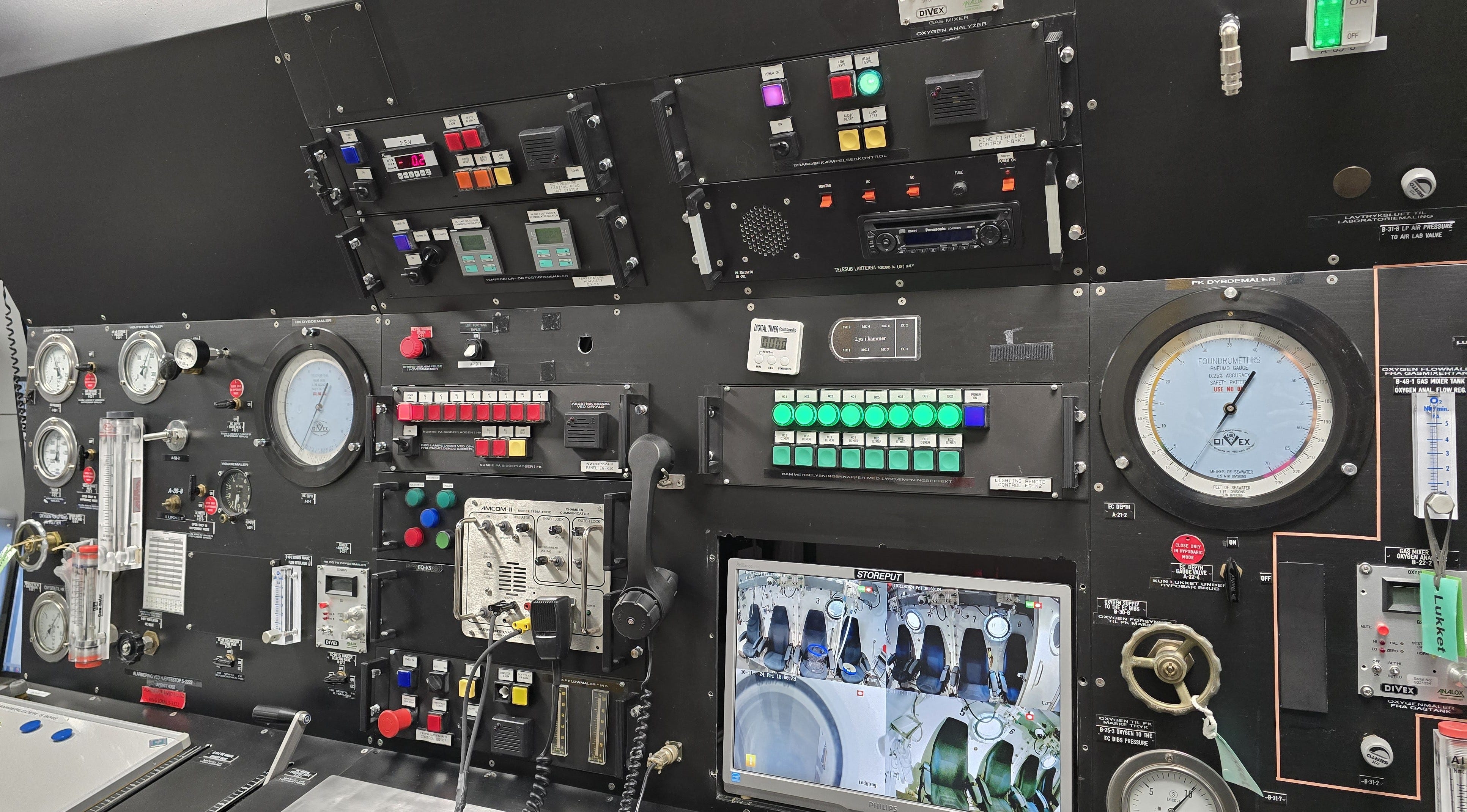
Image caption: around the back side of the chamber is massive control panel, including video surveillance of the inside, that looks like something out of a movie! My own picture.
HOW DOES HBO2T WORK?
HBO2T involves breathing pure oxygen in a pressurized environment – usually two to three times the normal atmospheric pressure that surrounds us every day. That’s equivalent to being fourteen meters or eighteen meters below sea level. In these conditions, your lungs can absorb more oxygen than would be possible breathing pure oxygen at normal air pressure.
Many patients need multiple HBO2T sessions in the chamber – with the number depending on the specific illness or medical condition. Some conditions, like NF, may be treated in three ninety-minute sessions on three consecutive days – just as I was. Other conditions, such as wounds that have difficulty healing or radiation injuries from cancer treatment, may require as many as forty daily sessions.
Hyperbaric oxygen is a highly potent drug in its own right (16). Did you know that every cell in the body has an oxygen receptor? Your body’s tissues need an adequate supply of oxygen to function and when tissue is injured, it requires even more oxygen to survive.
Usually, oxygen is transported around the body by red blood cells, but during HBO2T a greater amount of oxygen can dissolve directly in the blood itself because of the pressure. As a result, the dissolved oxygen in the blood can reach areas of tissue with damaged or constricted blood vessels that are too small for red blood cells to be able to pass through.
Initially it was thought that the treatment effect of HBO2T in NF was primarily via its impact on the bacteria themselves, but it’s now known that the picture is far more complex. The additional oxygen is not only anti-bacterial – i.e. negatively affecting the bacteria and slowing their spread – but in addition it enhances the efficiency of the antibiotic treatment (16). On top of that it seems to also have a range of positive immune-modulating effects – in other words it directly affects how your immune system responds to the infection and the toxins released by the bacteria (15).
DOES HBO2T REALLY WORK FOR NF?
That’s a question that has been hotly debated for decades and it’s still difficult to be absolutely sure. There has been a lack of well conducted research studies and the results from those that have been done are frequently hard to clearly interpret as there are so many other factors at play that affect the chances of NF patients surviving.
For example, there have been different HBO2T treatment protocols – in other words when the patient is treated, for how long, and for how many sessions. Add to that there’s always variation in how long the patient has been sick for and how far the infection has progressed – for example it may be a single day and sepsis for one patient and three days and septic shock for another. If they’ve been transported from another hospital to the chamber location that can also affect their chances of survival.
And of course, it doesn’t stop there - patients have other things wrong with them (co-morbidities that I mentioned previously) which also affect how they respond to this type of treatment. Plus, these infections can be anywhere in the body and their scale and location will affect the severity and the bodies’ reaction to them.
After saying all that the data available does suggest that we now probably have the best indication that HBO2T does indeed help. It seems to reduce the chances of patients dying from NSTIs (of which NF is a subset) in the first 30 days, with a more pronounced effect for the more severely sick patients (17).
WHAT ARE THE RISKS OF HBO2T?
Generally, it’s a safe procedure and serious complications are rare. But it does carry some risk. For example, patients can sustain middle ear injuries, including leaking fluid and eardrum rupture, due to changes in pressure.
I have heard mention of at least one hospital in Australia where grommets (tiny ventilation tubes that are put inside the eardrum) are inserted in NF patients’ ears before HBO2T to reduce the risk of ear injuries. It’s a nice idea, but I would guess it’s not done as standard as the focus is on keeping you alive and treating the infection.
It can also cause temporary near-sightedness – a collapsed lung – and in rare cases seizures as a result of too much oxygen in your central nervous system.
The true risk of these chambers is not really related to its effects on the human body, nor the pressurization of the chamber, but rather comes from the flammability of the pure oxygen. So, safety is very carefully controlled and maintained.
THE REAL DEAL
By some strange twists of fate and more than a few lucky coincidences – and probably a little bit of serendipity – I had the opportunity to visit the hyperbaric chamber in which I was treated in October 2023.
They were running tours of the unit as part of ‘Culture Night’ – an annual event in Copenhagen. Each tour was meant to be for a group of twelve interested people. But in the end it was just a good friend, who happened to be over from the UK, and me. Not only that, but we had the privilege to meet and hear from the professor that runs the entire unit. It felt like it was meant to be.
The whole thing gave me goosebumps. I was fascinated, awe-struck, moved, and acted like an overwhelmingly enthusiastic fangirl. Obviously, I have no memory of the treatments in the chamber – I was in my induced coma – so it was incredibly special for me to see it and meet some of the team that had contributed to my survival.
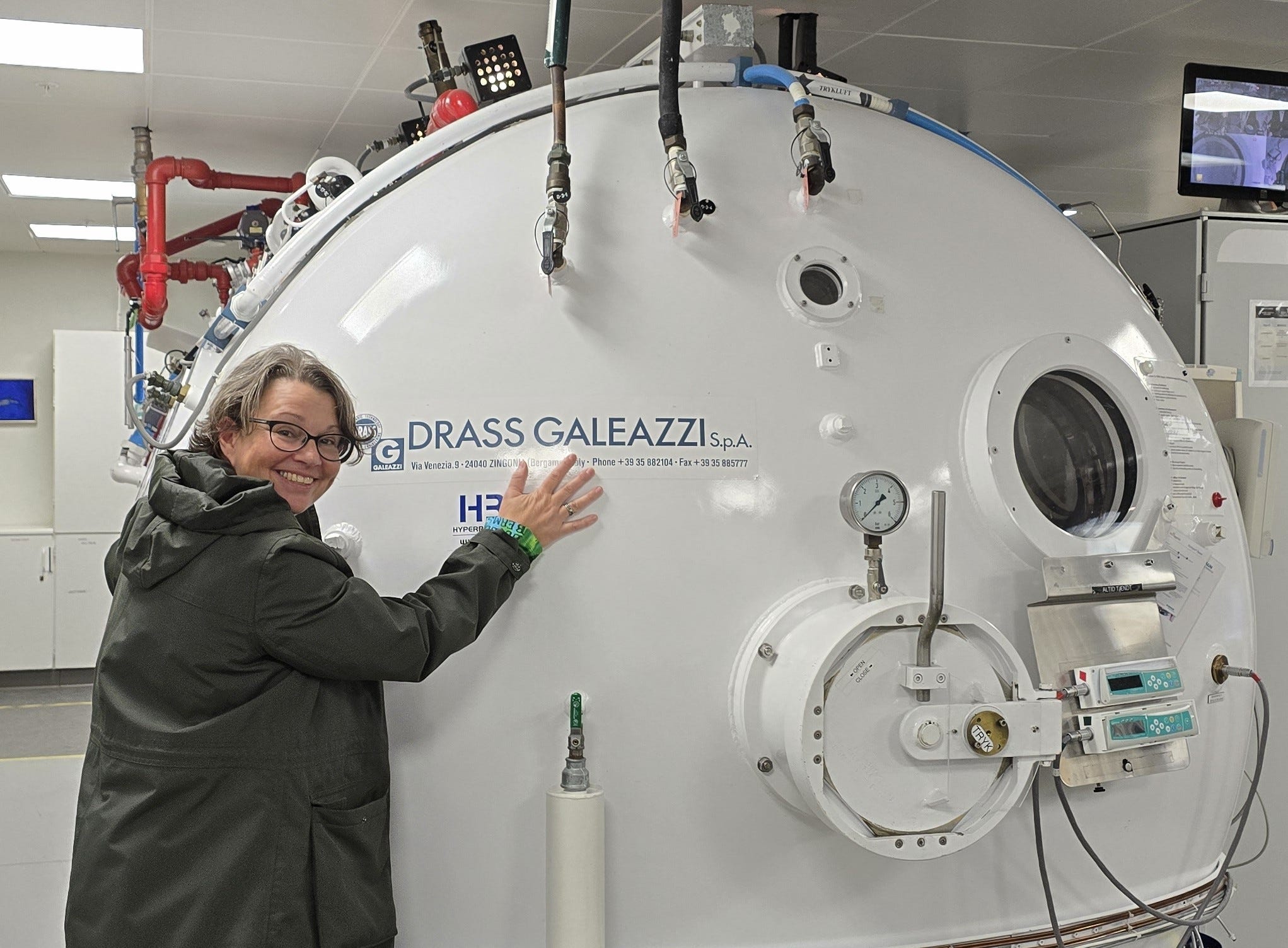
Image caption: I didn’t intend to include this picture, but in the end I felt that it just had to be done. I wanted you to see that smile. I loved visiting the unit so much. My arms wouldn’t wrap all the way around it, but this was me doing my best to give the chamber a hug to say thank you! The picture was kindly taken by one of the divers on duty that day and yes, I definitely said thank you to the chambers human operators too.
The chamber is run not only by the medical team associated with it, but it is also manned each day by two professional divers who keep the chamber itself functioning. They operate 24/7 and have a one hour ‘scramble’ time at any time of the day or night for urgent (i.e. acute) patients like me. That’s the time it takes for them to be onsite and ready for a patient. I felt like I had been rescued by an underwater team from Top Gun! (See what I mean about the over-enthusiastic fangirl?!)
This chamber is the only one in Denmark that can take intensive care patients. I was lucky the hospital where I was initially admitted was only a relatively short drive away. Other NF patients in more remote areas have to be driven, or in some cases flown by helicopter, to the hospital with the chamber. That transport is a risk for any critically ill patient, another stress they don’t need, another delay to treatment, and sadly some have died on the way.
The chamber itself has eight seats – their design a bit little like those on a plane – that face each other down each side of the chamber. They have up to seven seated patients in there, with a diver to help with their oxygen hoods. Or alternatively they flip the seats up to make space and have a patient, in a bed, lying down the center of the chamber. Entirely alone.
Though they can do it much faster it usually takes ten minutes to take it ‘down’ and pressurize the chamber. It remains under pressure for some ninety minutes. And it then takes fifteen minutes to gradually release the pressure and come back ‘up’. It’s not that it needs to take that long, but as I was told, that’s the most comfortable way to do it.
Once you’ve been connected to the oxygen supply, in whatever form, then a doctor monitors the patient(s) vital signs on monitors on the outside of the chamber. I was surprised there was no doctor or nurse in with me as I’m convinced somebody had told me there was someone. But who knows where I got that from.
The chamber has two sections. A larger patient section that is sealed off from an airlock on one end. If a doctor needs to get to a patient once the chamber has been pressurized, then it takes just 25 seconds to get them into the chamber via that airlock.
I know that the team that run the chamber are very proud that in 2025 they will open a whole new HBO2T unit with two chambers, each seating twelve people, plus two single person mono units. It will be the largest unit of its type in Europe and has been made possible by a large donation from a foundation.
I am incredibly grateful for their efforts to help save my life and hope they’ll be able to treat many more patients with their new facilities.
COMING SOON
Chapter 23. A Life Changed - next Thursday (23rd October)
If you are unlucky enough to get NF what are the possible medical consequences - including skin grafts, amputations, and even transplants. What is going on in terms of NF research, including possible new treatments on the horizon. And finally, how can you find your community and people that you can relate to…
References
Many of the same references are used repeatedly across these three chapters of the book so if you’re interested in getting back to some of the source data I’ll be publishing a list at the end of Chapter 23 along with a few useful websites.
If this post made you feel something then I’d love it if you would click on the heart and add a comment about what resonated for you – it means a lot to me to hear from each of you.
If you would also be kind enough to share it that will help more people find Hold My Hand and learn more about these awful infections. Maybe one day that knowledge will save a life.
Thank you!
If you missed any previous chapters from the book then you can find them easily on my website – click HERE and it will take you directly to the webpage dedicated to the book where you can read or listen to any previous chapters that you might have missed.
Every THURSDAY I’ll continue to share my ‘book in parts’ - Hold My Hand: A Journey Back to Life - chapter by chapter.
Wow ! I never knew this , I’ve heard of the bends and met a diver when I lived in Scotland who suffered from this, Fascinating stuff !
A fascinating description of the hyperbaric chamber you were treated in plus wonderful photo of enthusiastic fan hugging it! It is a really special piece of kit and it is so interesting to hear of the divers, the work they do and the expansion of the unit and chambers. Very good to have this knowledge Jacqui and thank you for sharing it with me